|
 Well, first there were large bulky LOUD fixed SCSI hard drives. Well, before even that, Emu put 20mb and 40mb hard drives that weren't really SCSI but they tapped into the Emulator II motherboard and allowed fast I/O for loading banks real quick. Well, it was more like twice as fast than floppy. Nowadays, the speed increase is 100x or more. Well, first there were large bulky LOUD fixed SCSI hard drives. Well, before even that, Emu put 20mb and 40mb hard drives that weren't really SCSI but they tapped into the Emulator II motherboard and allowed fast I/O for loading banks real quick. Well, it was more like twice as fast than floppy. Nowadays, the speed increase is 100x or more.
Drives like this dominated samplers for many years.
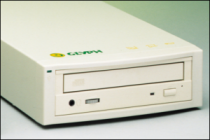 Wait... actually, within the innovation that was Emu, they worked with a Silicon Valley company named OMI - Optical Media international, to work out a CD-ROM data solution. BOOM - there were these THREE EII CD-ROM's. What a deal. Wait... actually, within the innovation that was Emu, they worked with a Silicon Valley company named OMI - Optical Media international, to work out a CD-ROM data solution. BOOM - there were these THREE EII CD-ROM's. What a deal.
Not to be outdone, Akai put SCSI on their S950 sampler 9and outgrowth of their S900), and then with their S1000 sampler, thousands of CD-ROM titles - due to the diligence of the German company Best Service - came to be. This launched a cottage industry of THE SAMPLE DEVELOPER. Nowadays we see huge firms, such as Spitfire Audio, Orchestral Tools, Output, Vienna Symphonic Library, and many others that specialize specifically on sounds for samplers. Most of those firms make their own software samplers. But it all started with the CD-ROM and the ability to put mass storage on a single platter.
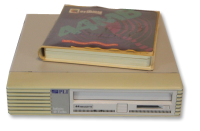 So, WHY DOESN'T THAT SAVE BUTON WORK WITH THE SCSI CD-ROM DRIVE???? Well, duh... but how do you save your own sounds? Enter the innovator Syad Iftikar and his company Syquest. Starting back to 1982, Syquest made removable platters, which essentially enabled the hard drive platter to be removed from the hard drive. The desktop publishing industry had the same problem of excess storage and portable movement of files (remember, there was no practical Internet then). When SCSI hit the sampler market, Syquest just released their SQ555 44mb drive (pictured to the left). That became for awhile the industry standard for the power SCSI sampler user. (Click here for a history of Syquest - quite fascinating.) So, WHY DOESN'T THAT SAVE BUTON WORK WITH THE SCSI CD-ROM DRIVE???? Well, duh... but how do you save your own sounds? Enter the innovator Syad Iftikar and his company Syquest. Starting back to 1982, Syquest made removable platters, which essentially enabled the hard drive platter to be removed from the hard drive. The desktop publishing industry had the same problem of excess storage and portable movement of files (remember, there was no practical Internet then). When SCSI hit the sampler market, Syquest just released their SQ555 44mb drive (pictured to the left). That became for awhile the industry standard for the power SCSI sampler user. (Click here for a history of Syquest - quite fascinating.)
 In that context, a similar technology appeared concurrently, one made by Iomega and concerned the Bernoulli physical principle. There was the Bernoulli Box and the Bernoulli 150, released at the same time as the Syquest 44mb, and were less successful. In that context, a similar technology appeared concurrently, one made by Iomega and concerned the Bernoulli physical principle. There was the Bernoulli Box and the Bernoulli 150, released at the same time as the Syquest 44mb, and were less successful.
However... Syquest had nowhere to go but down, due to reliability concerns, but also the price of the cartridges. Iomega took full advantage of this by releasing the smaller ZipDrive, which featured 100mb disks that sold for much less and were about the size of a floppy. (Note: the ZIpDrive was helped by Bernoulli research but did not use the Bernoulli principle in it's operation). For many, many years, even up to the mid-2010's, ZipDrives ruled the landscape as far as sampler storage was concerned. The Zip250 certainly helped. Even though there was a hiccup with the Click-Of-Death syndrome, the ZIpDrive stayed as the de facto storage medium.
INTERMISSION: With the rapid rise of the software sampler, older SCSI-based hardware samplers fell into disuse. Even SCSI quickly lost "cache" with the appearance of USB. All this seemed to go into the realm of Where Are They Now reality. But... although whispering, life was bubbling up behind the scenes, under the radar...
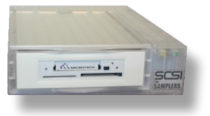 Coincidentally, several technological advances happened at the same time in early 2000's. We already discussed the shift from SCSI to USB. At the same time, the Memory Card appeared, starting with Smart Media, then Compact Flash, the the current SD technology. Coincidentally, several technological advances happened at the same time in early 2000's. We already discussed the shift from SCSI to USB. At the same time, the Memory Card appeared, starting with Smart Media, then Compact Flash, the the current SD technology.
But due to the almost instantaneous shift from SCSI to USB, and the almost simultaneous appearance of Card tech, the concept of a SCSI Card Reader almost never happened. The only real attempt of this was the Toshiba PCD-47B (pictured to the left), and it was manufactured in such low quantities that it was very hard to acquire.
Enter SCSI For Samplers. This company, owned by J. D. Wilson, tried valiantly to collect all the PCD-47B, PCD-50, and other rare models of SCSI Card Readers and make them available to the sampler community. This writer, incredibly, never purchased one from them, because most of the time their were out of stock.
As time went by, SFS had less and less to sell, to where they just stopped doing business. Only lucky people owned a SCSI Card Reader. What needed to happen is someone to manufacture one - but how? Only large companies could do that, and they weren't interested.
Note: The rest of the story is written from our personal perspective, which is interesting in and of itself.
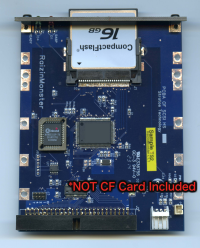 Enter the small, smart, innovative entrepreneur. Rather, entrepreneurs. From our perspective, the first was a company (that still exists) named Artmix, from Japan. They made a product called Raizen Monster, a CF card reader/writer that used SCSI. We still have one here, it was a real nice unit. But it was sold just as a circuit board, no case. Other people were aware of this as well, and all of a sudden there because a big market for old Syquest EZ135 SCSI cases. Enter the small, smart, innovative entrepreneur. Rather, entrepreneurs. From our perspective, the first was a company (that still exists) named Artmix, from Japan. They made a product called Raizen Monster, a CF card reader/writer that used SCSI. We still have one here, it was a real nice unit. But it was sold just as a circuit board, no case. Other people were aware of this as well, and all of a sudden there because a big market for old Syquest EZ135 SCSI cases.
But limitations of the Raizen Monster became apparent. One was the "boot time" - yes, Card Readers have a firmware startup process - if a person wanted to replace their floppy drive with a Raizen, that meant the drive had to power up simultaneously with the sampler - and for some the Raizen didn't boot in time. Also, the ArtMix folks knew little English and when issues occurred, there usually was no resolution.
At about the same time, there was a solution that instead of using CF cards, it used SD cards. It purported to be open source and didn't seem to be for real. The ArtMix card was beefy and sexy and cool. It fit a regular floppy-sized 3.5 form factor, This "other" solution used a non-standard dimension - what case could it fit in???
After relocating our business to Nashville, we were selling off some of our gear, and one thing to go was a Kurzweil K2000. We got a buyer, the keyboardist for Thomas Rhett, and he was local in Franklin, just outside of Nashville., so we took it over to him. When we set it up in his studio, he pulled out the teeny-tiny (size of my palm) black case, hooked it up via SCSI and put this even teenier-tinier microSD card the size of my finger tip in. He formatted the SD card, and I was blown away.
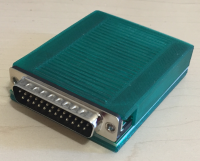 I went back to the office and did some research. First, the case was 3D-printed and the design was available online. Second, the technology behind it was that open-source bad form-factor SD design, called SCSI2SD. I then found out the clincher: a single SCSI2SD unit could be visible to the host as 4 - or as many as 7 - drives! I went back to the office and did some research. First, the case was 3D-printed and the design was available online. Second, the technology behind it was that open-source bad form-factor SD design, called SCSI2SD. I then found out the clincher: a single SCSI2SD unit could be visible to the host as 4 - or as many as 7 - drives!
That was it for us. We ordered a bunch, designed our own cases, then SCSI2SD upgraded to v5 and v6 to be even better. The Sampling Public has never looked back.
Even better - yes there is a better - for the past 5-6 years there's been a resurgence in Vintage Samplers, most of which use SCSI. Ensoniq EPS. Akai S1000. Emulator III. And on and on. SCSI2SD has no power-up time issues, so it can be used internally. SCSI2SD also has no compatibility issues - it works with ALL samplers. When problems occur in the design, the founder works on the firmware and fixes things when issues come up.
So, even though there may be advances in the future, it sure isn't like it used to be - limited storage, mechanical units that easily break, limited compatibility and sketchy support. Now, SCSI SD card solutions are mass manufactured and quaranteed a place in the future. |