
|
Emu Emulator II Floppy Image Information |
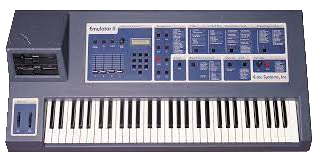 |
For such an old sampler, the Emulator II is quite amazing. It stores samples as 8-bit, but it has a scheme where those 8-bits are non-standard and encoded where they sound a lot better than that. And since the samples are stored as 8-bit, you have about 17 seconds to work with within each bank. A single floppy image holds a single Bank, which can hold up to 100 Presets that access up to 100 Voices (sample objects). Voices can be shared among Presets.
Translator also supports the EII SCSI format, and works similarly to the Roland S550 / Emu Emax I system where each "area" is a single Bank that would exist on a regular EII floppy. So the rules are the same, it's just a different format. (Remember that these larger image files need to reside in the Images folder for Translator to show them in the Virtual Drives area on the left.) The EII's playback sample rate is 27777 Hz, and Translator will usually downsample to that rate to save on (precious) memory. Please note that upon creating EII IMG files with Translator, you must convert them to HFE format using the HxC Utility, noted above, to use them in your Emulator II. Conversely, to use EII HFE files in Translator, you must convert them into IMG files using the HxC Utility as well. |
| Floppy Disk Image Format Information Floppy Image Support may not seem very earth-shattering, but it took a lot of innovation to get this right. The largest problem to solve was how to take larger Instruments ad compress them into smaller packages while still having them sound and play the same. Put another way, with software samplers, and also many 1990's-era samplers, you got used to 32mb, 16mb, 8mb, even down to 2mb Instruments. Samplers that rely on floppy images only are smaller than that, typically less than the size of single floppy disk; that is, 512k or 750k or 1mb. The problem isn't just memory, it's also the object count. For example, the Akai S900 only allows 32 samples per program. Even stricter, the Mirage allows only 16. That's the main aim of the technology, which we've dubbed Automatic Instrument Reduction technology (AIR). However, it can be used in larger situations too, such as 2mb samplers like the Ensoniq EPS/EPS 16-PLUS, or even the 8mb max Emulator III and Emax II. Who knows, even the 16mb/32mb - even the 64mb Triton and K2000 - hardware samplers, can benefit. 'AIR' involves eliminating layered sounds via combination, reducing the amount of samples within a keymap, downsampling, and proportional data truncation. It keeps in mind looped and non-looped sounds, and single-key maps. Along with that, we have changed how floppy images are dealt with in the Translator interface. They are no longer required to be the Images folder but can exist anywhere on your hard drive. Translator sees these floppy images - most usually using a IMG extension, but we have included other historical extensions such as EM1 (Emax), OUT (Roland), and EDE/EDA/GKH (Ensoniq EPS), among others. It then figures out what format they are and displays them accordingly. Gotek HFE Files (The exception to HFE is Emulator II images, which still require HFE. For that format, you need to convert the EII IMG files Translator creates into HFE using, again, the HxC Utility.) Channels and Sample Rates Regarding sample rates, perhaps a little explanation can clear things up. When Translator reads a format and gets that information ready for the new format it is translating to, it reads the POSTED sample rate that the sound data, when played back, will have the same pitch as it was recorded with. (We trust that it is correct; we weren't there when the recording took place.) Given that, most vintage samplers are more honest about their capabilities, meaning that they have one or two fixed playback rates. So how do you correctly play back a 44.1k sound on a sampler that plays back only at (say) 27400 Hz? That's what the Coarse Tune and Fine Tune are for - to compensate for that. Those of you that are familiar with Akai samplers in the S1000/3000 know what I am talking about - in the Keygroups you'll see pretty wildly drastic Coarse and FIne Tune values. That's why - the S1000/3000 only plays back at 22050 or 44100 Hz. Many Spectrasonics titles were recorded at 48k, so you will see lots of tuning adjustments of -1.47 semitones - that's the difference between 44.1k and 48k. Translator does the same thing, though it goes a step further. If there is a need to save on memory - which there usually is - it'll downsample the sound to the playback rate (or further down) instead of applying drastic Coarse/Fine tunes. (Although it's the amount of sample reduction that is desired here.) Of course this may affect the loop, if it exists, so Translator will add some loop crossfading to help matters. Translator doesn't have to downsample to the natural playback rate, since it can always set the Coarse/Fine tunes to make up for anything, but it defaults to the natural destination rate because it makes programming clearer and simpler. However, if the natural won't make the incoming Instrument small enough, it might go lower and thus raise the tuning to compensate. Think of "sample rate" as just a tuning parameter. Assume - we have to - that a sound's recorded rate was 44.1k. So, if you have a "true" sample rate parameter that you can adjust (the EPS/ASR is an rare example of this), all you are doing is telling the playback engine to play it faster or slower - that is, it's a tuning parameter. Remember that the INPUT SAMPLE RATE of a sampler is not the same as the OUTPUT SAMPLE RATE, and sometimes it's not exactly clear what a sampler's playback rate is. For example, the Emax samples at 8 selectable rates, from 10k to 44.1k. And that rate is written into the sample header. Back in those days, the manufacturers assumed the only way you'd get sounds into their sampler was to sample with that sampler. So it is assumed that, at least in the Emax's case, that the INPUT and OUTPUT rates are the same, or at least the sampler cheats upon knowing what the input rate was when it was recorded. Lastly, FYI, remember when a sample rate is listed on a hardware sampler, it is usually for information purposes only! There's no better example of this than on the Emulator 4, where the sample rate of each sample is listed in it's full glory. But that's not what is going on behind the scenes - there actually is a Pitch parameter in the sample header data (that you can't touch from the E4's front panel) that defines the actual pitch adjustment as derived from 44.1k - the actual fixed playback rate of the E4. |
|